To offer appraisal services in Probably Stolen, join the Appraisers' Council when its representative offers membership, then display your certificate to attract customers seeking valuations. The service pays a base fee and an accuracy-dependent bonus, making careful inspection central to what you earn from an appraisal customer. Accurate valuation also matters when buying stock: the official game description warns that misjudging a rare item or its seller can leave you absorbing the cost.
Join the Appraisers' Council and display your certificate
The council representative introduces appraisal as an additional source of income for your shop, explaining that some items have a complex valuation structure. In the recorded offer, membership costs 85 credits, and the dialogue includes an option to ask her to return later. After the player joins, the representative provides training manuals and another magnifying glass, says the council will send customers, and promises to return in a few days.
The Beginner's Certificate shown in that sequence lists a base fee of 20 credits and names the cybernetic hand as an eligible item. Its display instruction specifically connects placing the certificate on display with attracting customers who want the service. Check the eligible-item list as well as the fee, because the certificate identifies what you can value at that stage.
Understand service fees and appraisal exams
An appraisal customer brings an item to the shop for valuation, and the payment combines a base fee with a bonus tied to the accuracy of your estimate. The listed base fee therefore describes only part of the payment structure, rather than a fixed total for every completed appraisal. Appraisal exams award further certificates that increase the base fee and unlock additional items for valuation. Treat those certificates as progression in both earning potential and the range of items you can assess, while using the certificate you actually hold to check your present eligibility.
Inspect a cybernetic hand before calculating its value
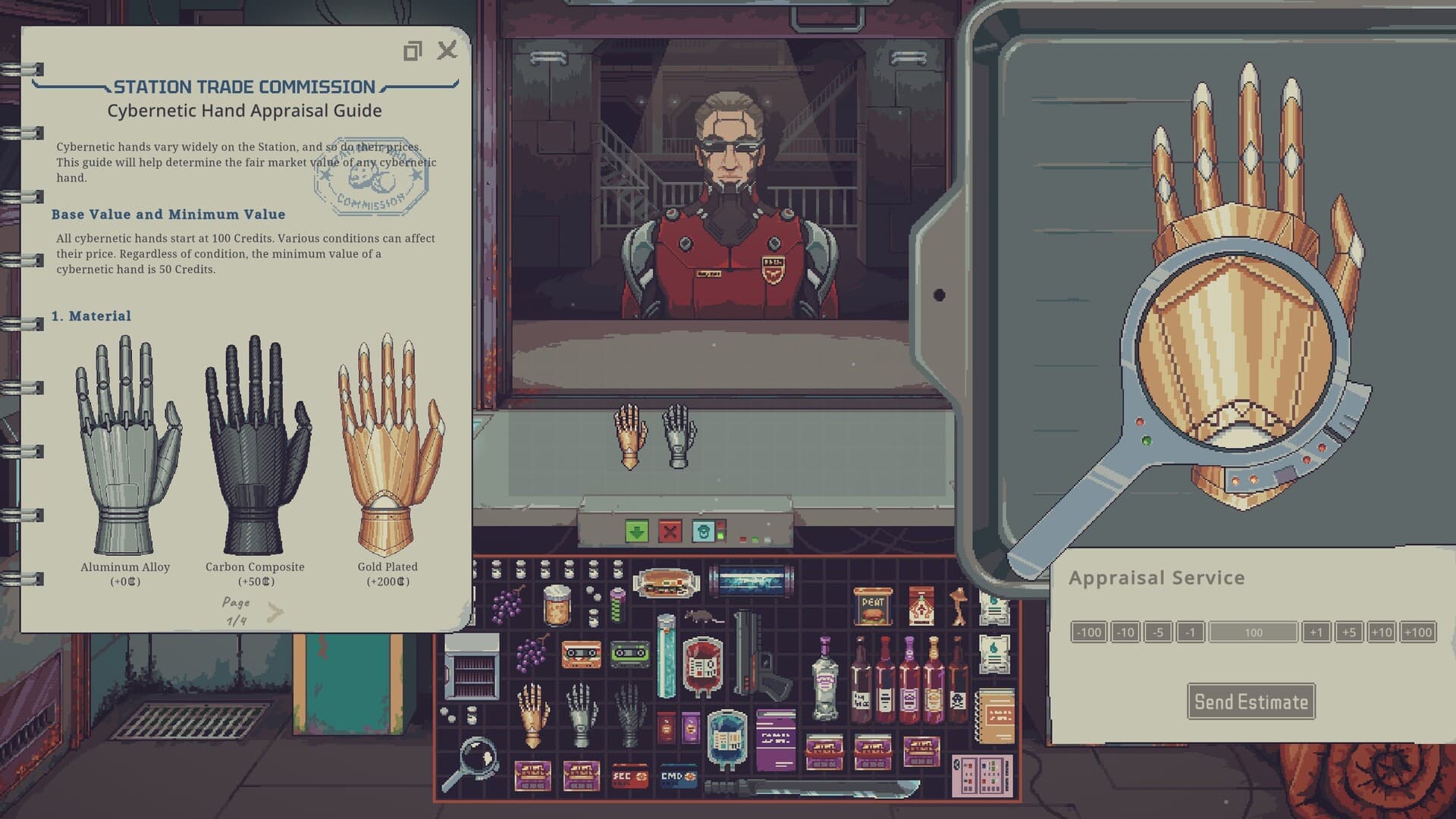
The cybernetic-hand guide read during gameplay gives hands a starting value of 100 credits and a minimum value of 50 credits regardless of condition. The player uses the magnifying glass alongside the valuation book to check material, condition, control interface, attachments, and possible combinations. Follow that inspection order as a practical checklist, matching the visible properties to the book before deciding which adjustments belong in the estimate.
The hand guide says attachment bonuses are independent and can be counted separately, while specified combinations can add value. Those rules make it worth checking attachments and combinations as distinct parts of the inspection instead of stopping once you recognize the material. During the second hand inspection, the player points out that adding values on the fly could miss a combination bonus involving EMG. Writing the calculation down is that player's suggested method for keeping track of the relevant details, rather than a mandatory operation imposed by the game.
Use the hand examples without turning them into fixed prices
In the first inspected hand, the player identifies carbon composite, good condition, an EMG interface, and no attachments or qualifying combination. The calculation begins at 100 credits, adds 50 credits for carbon composite, and leaves the other checked categories without an adjustment in this example. The player submits an estimate of 150 credits after checking the calculation against the book. The later results report perfect ratings for both inspected hands, supporting this worked example without establishing the same price for hands with different properties.
For the second hand, the player retains the carbon-composite addition of 50 credits but identifies a slightly dirty condition and applies a deduction of 35 credits. The dirt adjustment belongs to that inspection and should not be reused as a deduction for every possible condition. Compare the condition you see with the guide instead of assuming that a familiar material makes the earlier estimate reusable. Keeping material and condition on separate lines in your notes follows the player's written-calculation approach and makes the changed adjustment easier to track.
Keep community appraisal aids separate from game features
A community tool creator describes an inspection aid that runs on a mobile device or computer and lets the user select the item being assessed. According to the creator, its spoiler mode supplies a total price, while its no-spoilers mode supplies a checklist of the user's selections. These labels describe the external aid's behavior, so do not look for them as appraisal modes inside the game. If you prefer to work through the valuation yourself, the checklist option is the feature described for reviewing selections without receiving the tool's total.
The creator's demonstration also shows an inspection process using a magnifying glass and the in-game Ribwich identification document. The creator checks whether the packaging is closed, examines whether the logo is correct, and consults the identification rules while making selections. Keep any outside aid alongside the relevant in-game identification rules, with your selections reflecting what you can actually observe on the item.
Prepare the display and keep the shop attractive
Beyond displaying the service certificate, the shop-display explanation says that goods attract buyers and that more valuable displayed items of a given type attract wealthier customers. Choose what to display with the kind of buyer you want to attract in mind, while keeping the certificate's service-attraction role in view. Prepare the display before raising the shutter, because the explanation says items added later do not affect it until the next day. Moving an item into the display after opening therefore should not be treated as a way to change that day's attraction effect immediately.
The janitor-service explanation says payment empties the trash can and cleans the window, and that leaving the window uncleaned for a few days harms the store's attractiveness. It also says vandalism increases cleaning costs, giving you another reason to pay attention to the condition of the storefront. Check window upkeep alongside display preparation when considering how your shop attracts customers. The display rules describe the attraction effect of merchandise, while the cleaning explanation identifies a separate way the storefront can lose attractiveness.
Account for faction reputation when trading with customers
The official description connects attracting the right customers with balancing supply and demand, and says faction connections can provide exclusive deals. The negotiation tutorial gives a concrete reputation rule: offering a client a better trading price improves your reputation with that client's faction. For a buying client, that favorable price also increases their budget. Consider that relationship when negotiating shop trades, alongside the immediate price, since the tutorial links the offer to both faction reputation and the buyer's budget.
Demanding a higher price moves those trade effects in the other direction, reducing faction reputation and a buying client's budget. The tutorial says clients accept offers favorable to them, whereas acceptance of a higher price depends on your reputation. These are negotiation rules for trading with customers, so they should not be used as a formula for the accuracy bonus on an appraisal. When handling a valuation service, use the base-fee and accuracy-bonus structure; when negotiating a trade, account for the reputation and budget effects described by the trading tutorial.