To identify wanted customers in Probably Stolen, compare the person at your window with the photographs on the Wanted poster before they leave. Use the face as your reference rather than trusting the displayed customer name, because wanted criminals can appear under generic labels. Once you have a match, hold Call Security while the suspect is still present and check that the report has been accepted.
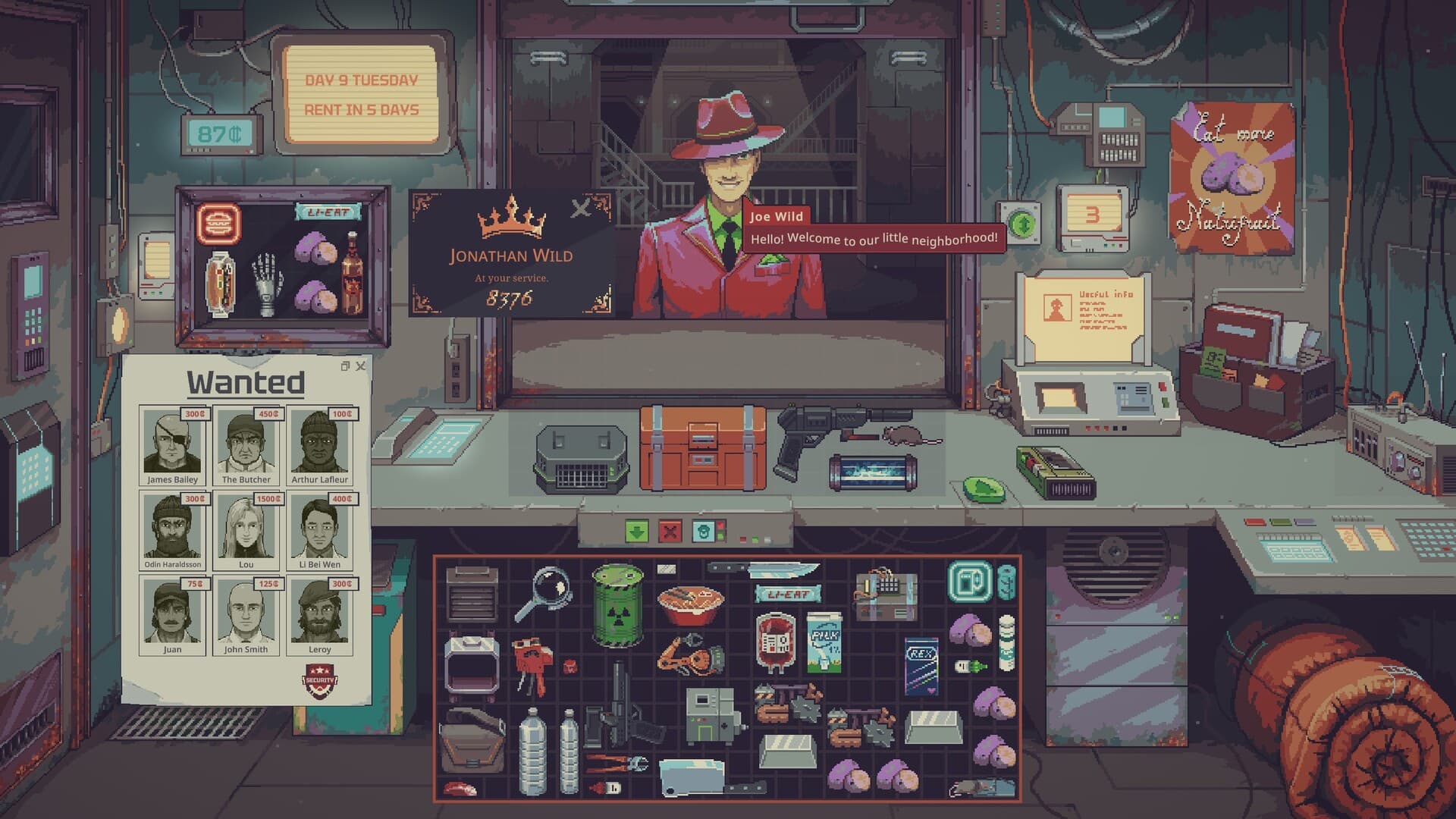
Use the Wanted poster to check faces
During the introduction, Officer Lun from the Security Department introduces the Wanted poster on Day 1. The Day 1 walkthrough describes him as the final customer in that queue, wearing a red beret and sunglasses. The poster is automatically added to your inventory and contains photographs of nine wanted criminals with their bounty amounts. Keep it in an accessible inventory slot so you can inspect it whenever a customer needs comparing.
Compare the customer's appearance directly with the poster while they are still standing at the window. A generic label does not rule out a match: in a reported version 100-REV3 run, The Butcher appeared as a Lower Level Citizen while wearing a red cap and bloody apron. The player identified him by matching his face to the poster before holding Call Security. Treat that outfit as a documented example from that run, rather than a replacement for checking the photograph.
Hold Call Security and confirm the report
The Call Security control is the teal button on the counter's control strip, beside the green and red buttons. Look for the tooltip reading Call Security for assistance if you need to distinguish it from the neighboring controls. Press and hold it for approximately 0.5 seconds, because a quick click will not activate the reporting mechanic. Make sure the matched suspect remains at your shop window when you make the report.
Some wanted customers plead when you first press the alarm, and that initial press does not count as a report. If this happens, press the alarm again to report them rather than assuming the plea means Security is already coming. After a report is accepted, the button tooltip changes to indicate that the current customer has already been reported. This confirmation distinguishes an accepted report from an initial alarm interaction that has not yet reported anyone.
Once the report has been accepted, wait for Security Officers to arrive at the window and complete the arrest. A criminal may react to the alarm or try to persuade you to stop even after a successful report. Those reactions do not require further action once acceptance is confirmed. The need to press again applies to the initial pleading interaction that did not count, so use the report status to tell these situations apart.
Know when wanted customers can appear
Random wanted-criminal visits begin on Day 14 when you play the introduction, or Day 5 when you skip it. Those dates apply to random visits rather than every possible appearance by a poster target. Arthur Lafleur can appear on Day 3 with the introduction, before the random-visit starting point. An Apprentice walkthrough on Price Gouge difficulty also records meeting him during that opening week and receiving a plea while preparing to call Security.
Odin Haraldsson and Lou have their own schedules, while the other seven poster targets each have a random visit. The Butcher, James Bailey, Juan, and John Smith also have their own return days after that. A day with a wanted customer has one fewer regular customer. Your starting perks matter as well: Known Snitch prevents anyone from the poster from visiting, so that setup cannot be treated as a normal opportunity to catch these targets.
Understand bounties and starting perks
The poster's base bounties total 3,600 credits across its nine targets, with Lou offering the highest amount at 1,500 credits. The Butcher has a base bounty of 450 credits, and Li Bei Wen has 400 credits. James Bailey, Odin Haraldsson, and Leroy each have base bounties of 300 credits. Juan and John Smith each have 125 credits, while Arthur Lafleur has the lowest base bounty at 100 credits.
Treat those figures as base values rather than a promise that every later visit pays an identical amount. The wiki distinguishes Odin Haraldsson's 300-credit reward from 350 credits on later visits. Starting perks also change report payments: Convict pays 25% less, while Model Citizen pays 50% more. Their Security gains are +4 and +8 respectively, replacing the usual +5 from a correct report.
Model Citizen costs one perk point and adds 30 Security reputation at the beginning of the run. Convict instead provides an additional perk point while starting you with 30 less Security reputation. These opening effects are separate from their changes to report rewards and reputation gains. When comparing the benefits of an arrest across runs, account for the selected perk rather than expecting the same payment and Security increase in every setup.
Avoid false reports and watch faction effects
Reporting an innocent customer costs 8 Security reputation, and you may also receive a 50-credit fine if your balance is at least 100 credits. The game forgives one wrongful report every five days, but that allowance is not a reason to guess at a face. Repeated wrongful reports produce increasingly serious warnings. The third warns of severe consequences, and the fourth warns that the next false accusation will result in arrest.
Correctly identifying a wanted customer can still have consequences for factions other than Security. In a documented run, reporting James Bailey caused a loss of Lower Levels reputation, while reporting Odin Haraldsson caused a loss of Revolution reputation. Odin's arrest also awarded the bounty and improved Security reputation. Read the notification after each arrest because the faction effect differs between targets, rather than assuming a uniform penalty for every criminal.
Check arrests, missed visitors, and other report types
A correct report normally pays the reward, increases Security reputation, crosses the arrested face off the poster, and leaves an Incident Slip on the counter. Use those crossed-out photographs to review which poster targets have already been caught. The Security tab of the run summary also contains Wanted Criminals Caught, which tracks arrests out of the nine listed criminals. The same summary's Wrongful Reports statistic lets you monitor mistaken accusations separately from successful arrests.
Letting a wanted customer leave does not immediately trigger a fine or reputation penalty. The next morning's night log can name the wanted criminal who visited the previous day. That feedback arrives after the completed visit, so it cannot be used to report the person during that encounter. For an arrest during the visit itself, the useful identification step remains comparing the face while the customer is at the window.
Call Security also handles customers attempting to sell stolen merchandise or contraband. Those transaction reports have payments separate from the standard bounties for the nine poster criminals. A seller being reportable for illegal goods therefore does not automatically establish that they are a Wanted poster target. Use the poster to establish wanted identity, and keep that question separate from whether the offered merchandise provides another reason to report the transaction.