To purify water in Probably Stolen, test it first, then use tablets, a filter, UV treatment or a purifier according to the contaminants present. Purchased basewater can reach high quality with UV and filtration, while water collected from pipes may need additional treatment. The key is to check the result after treatment: a method that works on a seller's basewater may not produce the same result with water you have processed yourself.
Test your water before choosing a treatment
The Water trader supplies testing strips, which you use by dragging a strip into the water source. Use this check when buying bottled water or water in other containers, rather than assuming that a purchased supply already has the quality you want. Testing and filtering are part of the game's stated water system, but the treatment you choose should reflect what is actually in the water.
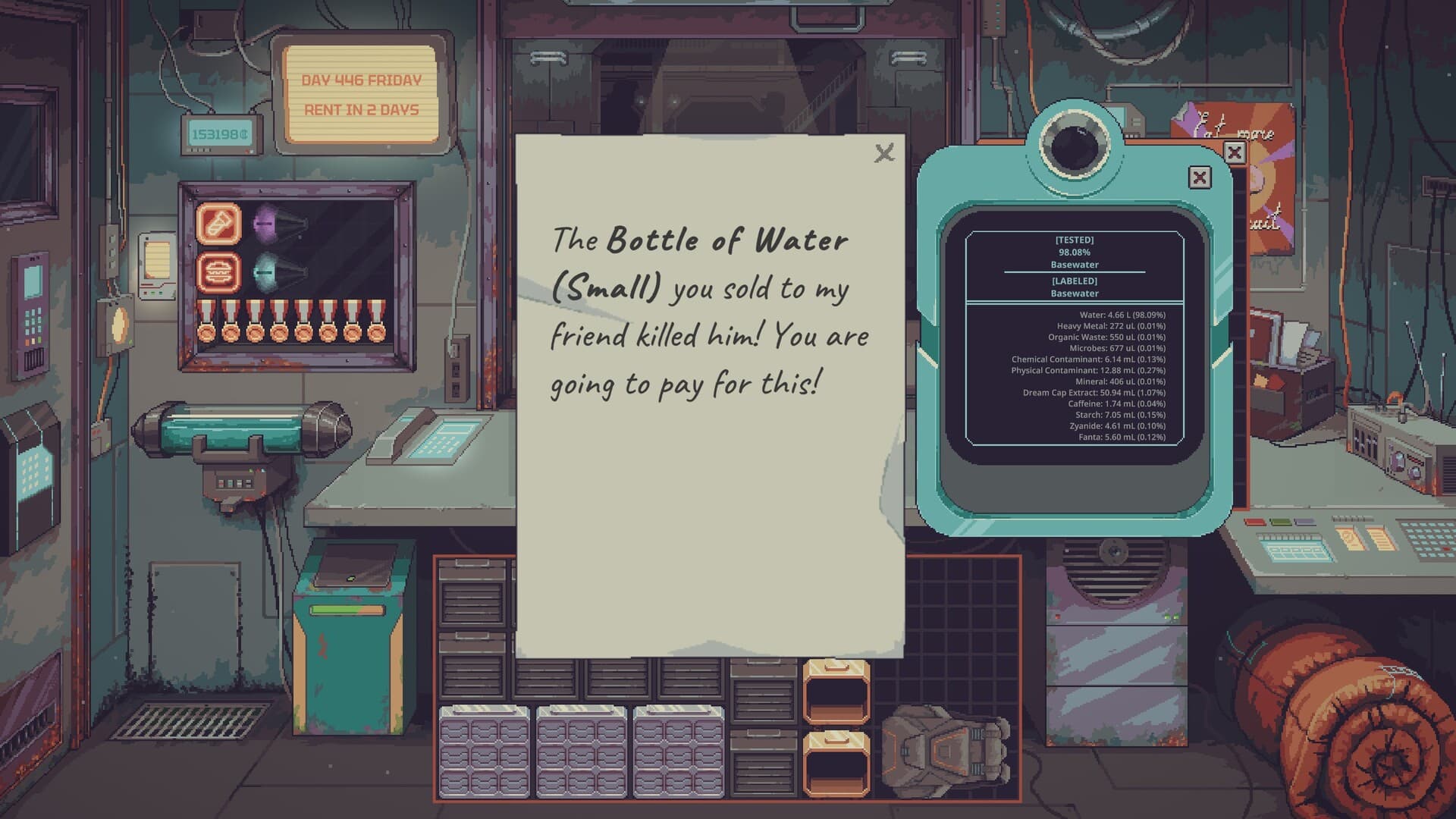
A water scanner gives you a more detailed picture by showing the contaminants, their quantities and the overall purity percentage that determines water quality. That makes it useful when a quality label alone does not explain what remains after treatment. Community players recommend AquaScan for understanding water processing and report finding it at Dr. Jackson's or through hydroponic vendors visiting the shop. Treat those locations as places to check, since the reports do not establish guaranteed stock.
Use tablets and a pitcher filter on purchased basewater
For a tablet-and-filter route, start with purchased basewater and put a purification pill into the container holding that water before you begin filtering it. Fit a filter to the pitcher, pour the unfiltered water into the pitcher, then transfer the filtered water into a separate container. A community report describes a chlorine pill followed by a Brita filter producing high-quality water from purchased basewater. Keep that starting condition in mind rather than treating the recipe as a guaranteed fix for every dirty water source.
If you need supplies, the Water Purification Tablets bottle holds only those tablets, with 9 in a full bottle. The Water Merchant start and the Water Trading starter kit are listed sources for the bottle, so access through those routes depends on that particular start or kit. Listed visitors who can sell the bottle at your counter include the Retired Water Merchant, Supplier, Supply Runner and Retired Chemist. These seller listings do not guarantee a daily visit or that every bottle offered will be full.
Understand what UV lamps and filters remove
The UV lamp removes microbes, while the water filter targets organic waste, mineral and physical contamination. These tools therefore address different parts of the water's contamination profile, which explains why filtering alone can leave an unfinished result. In a demonstrated example, filtered water remains basewater because microbes are still present. Applying UV treatment removes those microbes and changes that example to high-quality water.
The demonstrated UV-and-filter combination works on basewater bought from sellers because its mixture suits that treatment. If you make basewater yourself, the route used to produce it can leave a different mixture, and the same combination may not work. Scan your own processed water to see its remaining contaminants before deciding that a familiar quality label means it needs the same treatment as a purchased bottle.
Troubleshoot water that stays below the target quality
Check the filter's remaining durability if a tablet-and-pitcher attempt does not produce the expected improvement. Community troubleshooting specifically points to a filter with durability left and recommends testing again after treatment. That fresh reading matters more than relying on the label you saw before processing, especially when you are trying to establish whether the treatment changed the water.
Tablets and filters have a limit to how much they can clean, so repeatedly relying on that pair may leave some contaminants unresolved. Community advice for pipe water says an additional filtration step may be needed before it reaches basewater or high quality. Suggested additional routes include a purifying machine, gutter fish in a tank and hydroreed growing in a plant vat. Use the remaining contamination shown by the scanner to assess progress rather than assuming another tablet will solve every case.
Use a purifier and separate quality from performance
A demonstrated machine route starts with rustwater collected from a faucet and puts it into a water purifier. The purifier acts on all contaminant types, giving it a broader treatment role than either a UV lamp or a pitcher filter. This makes it another route to consider for water that needs more than treatment aimed at a specific contamination category.
In the machine demonstration, reaching full charge triggers the consumption of a charge and starts a processing cycle that runs for a day. You do not have to sleep through the night to trigger that treatment, and the demonstration says the process can be sped up. Whether an entire jug finishes overnight depends on the machine's performance, so check the actual result rather than assuming every purifier completes the same amount in that time.
Purifier quality controls the demonstrated purity ceiling: at quality of 100% or above, the machine can eventually reach 99.9% purity, classified as pure water. That is a condition attached to the machine's quality, rather than a promise that any purifier will produce pure water. If reaching the required quality is the problem, look for modules that provide quality bonuses. Keep this separate from performance, which affects how quickly the machine processes the water.
Consider fish and plants for additional cleaning
Gutter Tilapia can clean water over time inside a recirculating aquaculture system. The video demonstrator reports faster cleaning with more tilapia in the system and recommends checking the water periodically with AquaScan. Treat that as an observed relationship rather than a fixed rate or a guaranteed finishing time. Hydroreed growing in a plant vat is another community-reported cleaning route, without an established fixed processing rate in that report.
Use a Moisture Farm as an alternative water source
A Moisture Farm provides another way to obtain water, although it produces water rather than purifying an existing supply. In the demonstration, farm quality of 55 produces basewater, while increasing quality to 100 produces high-quality water. Another demonstration reports that a farm with quality of 150 or above can produce pure water directly. Consider that route when you can meet the relevant quality condition, while keeping it distinct from treating the bottles or containers you already have.