To use the Evaporator in Probably Stolen, place your prepared mixture in a compatible liquid container, insert it into the CONTAINER slot, supply an Energy Cell, and advance to the next day. The machine removes water and alcohol overnight, so it does not finish processing while you operate the shop. Check the remaining composition before continuing your recipe, because an overnight cycle does not guarantee a fully dry ingredient.
Get the equipment and prepare your mixture
Starting as Chemist gives you chemistry equipment, including the Evaporator, Blender, Heating Plate, Composition Spectrometer, and Chem Finisher. If you chose another specialization, the trade guide lists Retired Chemist from Wild as a chemistry unlock costing 1,000 credits. Its launch-build instructions place access to Joe Wild's Network on day 7, so treat that timing as launch-build guidance. The Evaporator's listed base item value of 300 Credits is a separate figure and does not establish the price of an equipment unlock.
Begin with the instructions for the product you actually want to make, preparing its ingredients and completing any required Heating Plate stage. Evaporation is optional for some mixtures and part of a longer required process for others, so this equipment sequence is not universal. Once the mixture is ready, keep it in a compatible liquid container and place that container in the Evaporator's CONTAINER slot. Make sure the machine has an Energy Cell before leaving the batch overnight.
Run the overnight cycle and check progress
The Chemist guide gives the starting Evaporator an operating requirement of 6 Energy per day. Use that figure for the starting equipment rather than assuming it applies unchanged to every upgraded configuration. The machine processes its connected batch container, so several prepared mixtures cannot all finish in that same Evaporator overnight. Choose the batch you want to process and confirm its container and power setup before advancing the day.
Compare the liquid volume before and after the overnight cycle: a reduction shows that evaporation occurred. That comparison answers whether liquid was removed, while the Composition Spectrometer lets you inspect what remains. Large batches and mixtures containing additional solvent may need multiple nights, even when the machine has successfully processed them. Continue drying until the remaining material meets the selected Chem Finisher recipe's requirement, rather than treating the first morning as an automatic finishing point.
Use the Evaporator for Dream Dust
For Dream Dust, attach a liquid container to the Blender and blend Dream Caps into Dream Cap Mush. Move the mush container to the Heating Plate, add Alcohol, and carry out extraction within 40–60°C before evaporation. After extraction, Kotton Fabric can filter large contaminants out of the mixture. Filtering is optional in the basic recipe, although it can help improve product quality; it is not a mandatory condition for starting the Evaporator.
Put the prepared extract in a powered Evaporator and let it process overnight until its water and alcohol are gone. Use the Composition Spectrometer to check the remaining mixture if you are unsure whether drying is complete. Then place the dry residue in the Chem Finisher, select Dream Dust, and press Output. Each vial uses 2 ml of residue, so the evaporation stage prepares the material for packaging rather than producing a finished vial inside the Evaporator.
Apply the correct Caffeine Pill conditions
Caffeine Pills start with Coffee Beans, which you blend into mush using the Blender and an attached liquid container. The heating requirement is at least 80°C, so do not copy the Dream Dust extraction temperature into this recipe. Filter when needed, evaporate the remaining water and alcohol, and select Caffeine Pill in the Chem Finisher to package the dry Caffeine. The shared evaporation step does not make the ingredients and heating conditions interchangeable.
The Caffeine Pill recipe lists a required volume of 5.00 mL and also rejects wet ingredients. Reaching the volume requirement therefore does not, by itself, establish that the material is ready to package. Check dryness as well as the amount of the relevant active ingredient, because a container's total volume can include water, solvent, or unwanted material. For this recipe, the active ingredient to check is Caffeine.
Fix wet ingredients and insufficient reagent
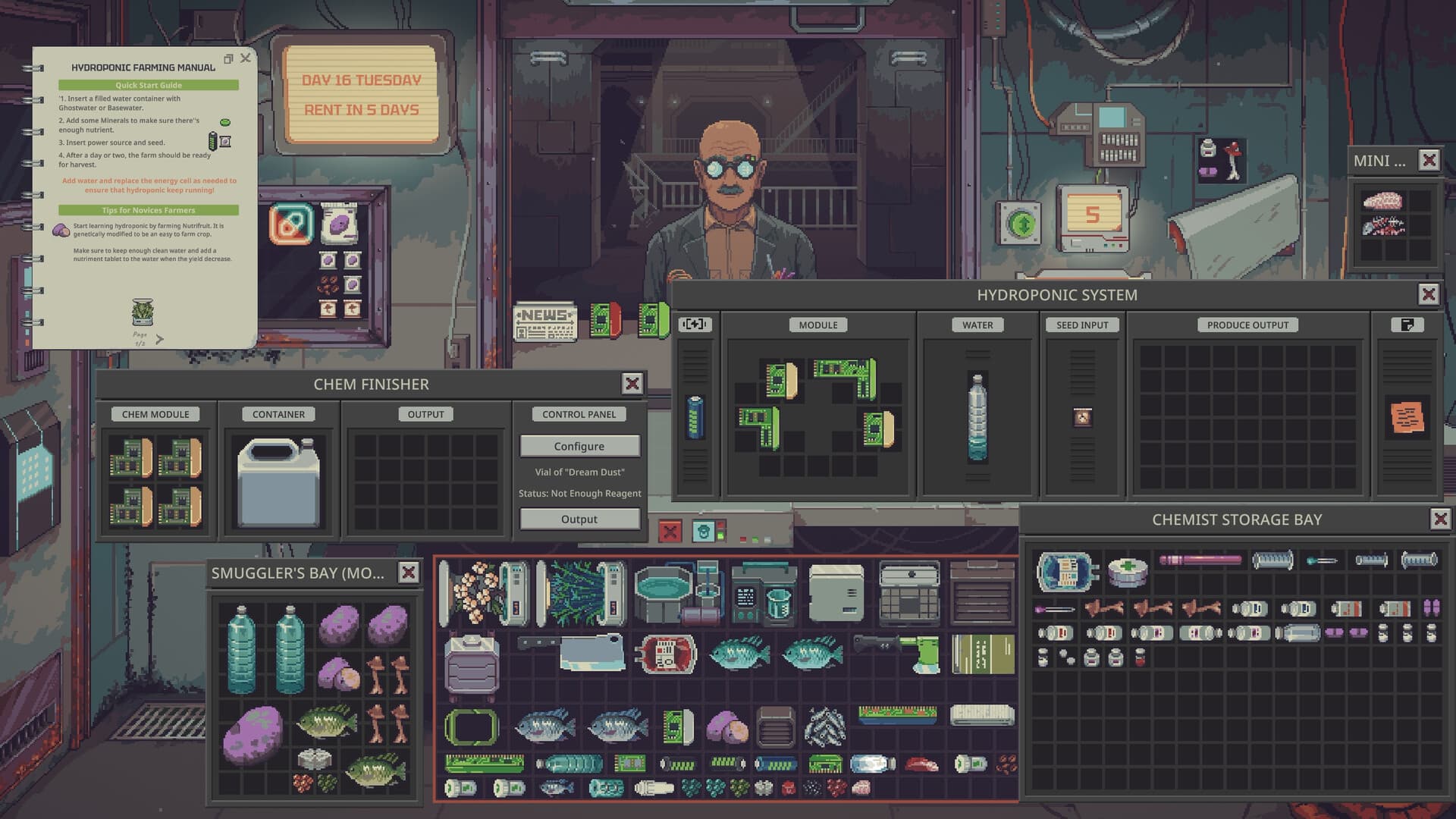
Wet Ingredient Detected means the input has not satisfied the Chem Finisher's dry-ingredient requirement. Check that the Energy Cell supplies enough power and that the mixture's container is actually in the machine's processing slot. Inspect the remaining Water and Alcohol, remembering that a larger batch can need longer in the starting Evaporator. If more drying is necessary, run another night and check the composition again before returning the material to the Chem Finisher.
Not Enough Reagent concerns the amount of usable active ingredient required by the selected product. Confirm the selected recipe, then check Dream Cap Extract for Dream Dust or Caffeine for Caffeine Pills. A large total volume can still contain too little active material if much of it is solvent or other unwanted content. Both warnings can appear together, so resolve wetness first and then verify that enough active ingredient remains for the recipe.
If Dream Cap material is weak or unusable, review the extraction temperature as well as the evaporation step. Heating above its permitted 40–60°C range can destroy valuable extract before the container reaches the Evaporator. Check the temperature before heating and monitor composition afterward to distinguish an extraction problem from unfinished drying. Further evaporation cannot recover Dream Cap Extract that excessive heating has already destroyed.
Understand an empty distillate container
A Steam community poster described losing Energy Cell charge overnight while the distillate container remained empty. Another player replied that recovering alcohol requires a specific module and that default operation removes water and alcohol. Treat this as a community explanation rather than an officially verified specification for alcohol-recovery hardware. The reply does not identify the module, so it does not establish a module name or a verified installation procedure.
For Dream Dust and Caffeine Pills, focus on the concentrate remaining in the original container. A reply in that discussion says it can proceed to the Chem Finisher once the water and alcohol are gone, consistent with the guides' dry-residue workflow. An empty distillate container alone therefore does not establish that drying failed. Compare the original mixture's volume and inspect its composition to judge evaporation progress instead of relying only on recovered distillate.
Separate drying, purity, and capacity problems
A dry product with poor purity does not necessarily indicate an Evaporator malfunction. Filtering removes large unwanted contaminants, while evaporation removes water and alcohol from the mixture. The Chem Finisher packages the remaining chemical and can introduce additional impurities, so dryness and finished purity are different checks. When reviewing a disappointing result, consider these separate stages rather than expecting extra evaporation to perform the filtering and finishing work.
The Evaporator uses normal modules, whereas most other chemistry machines use special Chemical Equipment Modules. Its improvements can affect energy efficiency and the amount of liquid processed each night. An additional Evaporator becomes useful when you regularly prepare multiple mixtures and the first machine is occupied overnight. That is a capacity expansion rather than a prerequisite for the initial Dream Dust cycle, since Chemist starts with the equipment needed and early purchases compete with rent, ingredients, and Energy Cells.