To haggle in Probably Stolen, start a shop-counter transaction, open the available bargaining options, and propose a lower buying price or a higher selling price. Inspect the item and review any displayed consequences before confirming, because the choices available can differ between customer interactions. Your aim is a price the other person will accept, with the item's value, the customer's spending limit, and your faction reputation all informing the decision. Pushing for a larger improvement can cost you the sale.
Use the bargaining options in the current transaction
Begin by reading the listed price at your counter and checking the item's condition alongside any visible price modifiers. Then open the bargaining choices offered in the trade interface and select an offer appropriate to whether you are buying or selling. Before accepting, read the indicated consequences and consider whether a smaller adjustment would make more sense for this particular exchange. Confirm only after weighing the proposed price against those terms, rather than choosing the most aggressive option simply because it is available.
When you buy, a successful lower offer reduces the Credits you spend to acquire the goods. When you sell, the goal is to raise the customer's payment without demanding more than that customer is willing or able to pay. The bargaining effects differ between these trade directions, so an approach that looks favorable while purchasing should not automatically guide your selling decisions. Use the choices and consequences shown for the current deal instead of expecting every customer interaction to offer an identical negotiation.
Assess the merchandise before arguing over its price
An item's base value is only part of the pricing picture, rather than a guaranteed final transaction price. Condition, purity, market modifiers, and the negotiated agreement can all change the amount exchanged. Suppliers can overstate value, and rare goods need proper appraisal if you want to avoid paying too much for them. That makes assessment a useful starting point for negotiation: establish what the merchandise is worth before deciding whether a proposed reduction actually makes the purchase attractive.
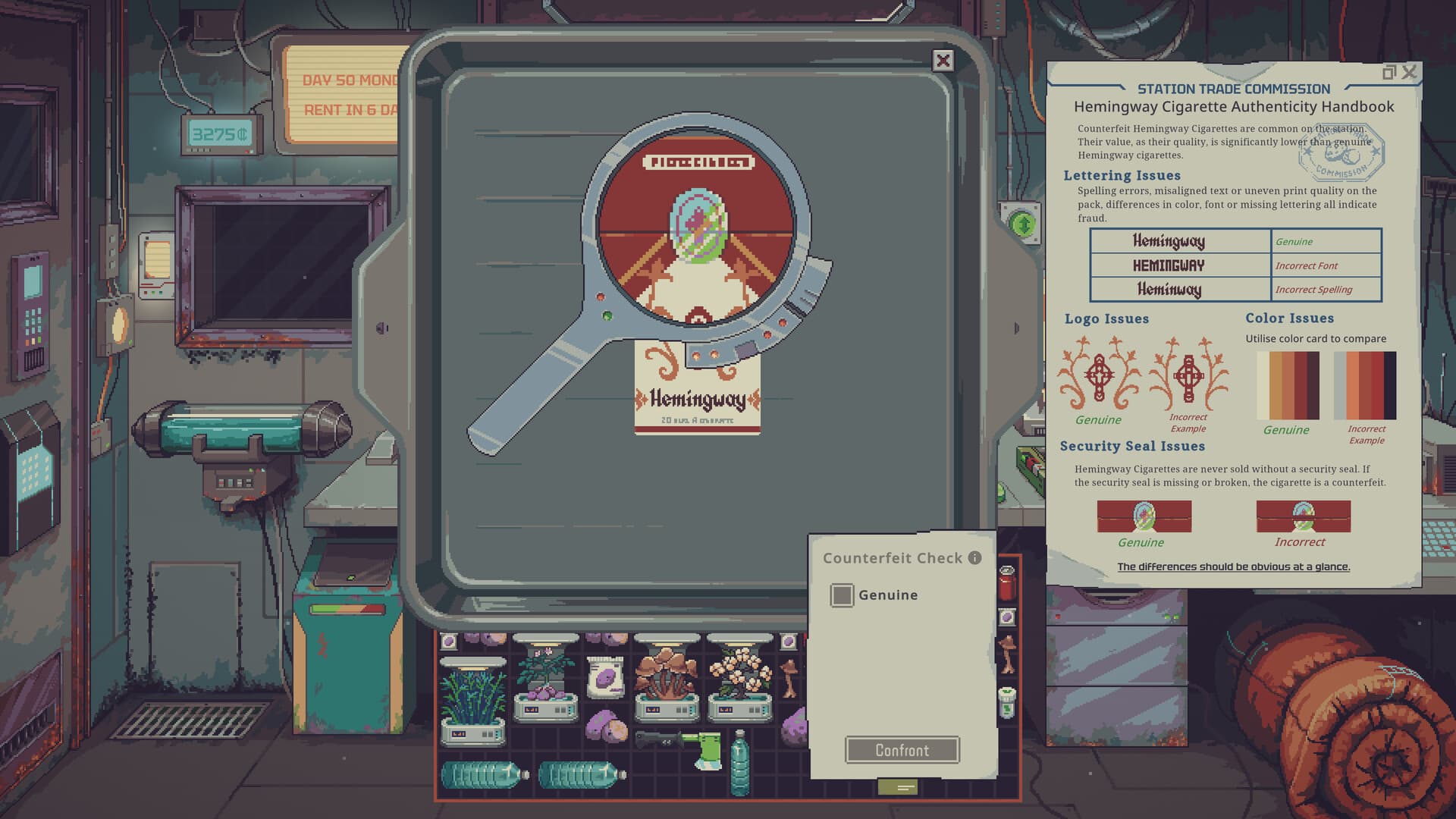
Use the magnifying glass and handbook to inspect goods before buying, especially when you suspect a mismatch between the item and its presentation. Counterfeit cigarettes, damaged injectors, and mislabeled water are examples of problems to watch for during that assessment. Finding a genuine discrepancy gives you grounds to confront the seller and obtain a lower price. An accusation based on a guess can instead damage your reputation, so separate a verified problem with the merchandise from a general feeling that the asking price is too high.
Recognize what the Hemingway example actually teaches
A first-week walkthrough using the Apprentice specialization on Price Gouge difficulty illustrates how inspection can support a price challenge. In that scenario, the Mentor supplies identification information for Hemingway cigarettes, covering the logo, seal, and color, along with a magnifying glass for closer examination. A later pack has both a broken seal and an incorrect logo, providing visible discrepancies to use when confronting its seller. The walkthrough shows that either identified issue can be used to get the scavenger to lower the price.
Treat this as an example of checking merchandise against its identification information, rather than a promise that your next customer will carry the same pack. The walkthrough notes that customers are randomized, so its particular encounter does not establish a fixed sequence for every playthrough. The useful lesson is to connect your challenge to an actual defect or mismatch you have identified. Applying that inspection-first approach also avoids treating a reputation penalty for a mistaken accusation as an acceptable shortcut to a discount.
Check customer interests and spending limits
If you are unsure what to offer a customer, open the tablet and look at the receipt's Interests section. It identifies what that customer is looking for, giving you a basis for choosing merchandise before negotiating its price. Customer matching matters beyond the receipt: station engineers favor modules and materials, while upper-level buyers are more willing to pay for quality. Appropriate goods in the window or display case can attract the corresponding buyers, helping you bring suitable stock and interested customers together.
Interest in an item does not remove the customer's spending limit, and an ambitious asking price can still be rejected. An unsuccessful bargain may reflect that customer's circumstances or an offer that demands too much, with excessive pressure sometimes causing the customer to leave. If the original price is already reasonable, consider a modest improvement rather than risking the exchange for a larger change. This is a practical decision rule for individual transactions, not a guaranteed offer formula or proof that a particular markup will always succeed.
Weigh faction reputation alongside the immediate price
Higher reputation can make people more willing to negotiate, and good standing with a group can make its members more generous and more willing to buy. The broader trading guidance also associates that standing with fewer scams, while low reputation can mean higher prices and fewer deals. These relationships concern different groups, including Security, the lower levels, the black market, and other customer factions. Think about your standing with the group involved in the current transaction instead of treating reputation as a universal relationship shared by every buyer and seller.
A failed interaction can damage faction standing further, which gives you another reason to consider more than the immediate price improvement. The game's official description presents bargaining as a trade-off and describes reputation as something that can provide access and protection while also attracting danger. That combination supports weighing a bargain's consequences rather than assuming the strongest possible demand is always the best choice. When deciding whether to proceed, consider the proposed terms, the customer's budget, and your relationship with that faction together.
Treat Blackmail and Threaten as separate risks
Blackmail and Threaten appear only in certain circumstances, and they should not be treated as ordinary haggling with a stronger effect. Failed blackmail, threats without support, and accusations directed at innocent customers can carry reputation penalties. Some outcomes can also end the interaction entirely, so the possible consequence extends beyond missing out on a better price. Evaluate these choices on their own displayed terms rather than assuming that their availability means they are a safe way to improve an otherwise acceptable transaction.
Account for market changes and wholesale discounts
Market context can change whether an offer is worth accepting, even before you choose a bargaining option. The first-week walkthrough describes events affecting prices and explains that abundant supply can push prices down. In its example, the Mentor warns that materials will not sell for much the following day. Use that example as a reason to consider current market conditions, rather than assuming that an item's base value alone tells you what a customer should pay.
Wholesale purchasing offers another route to a discount, but that benefit comes from buying wholesale rather than from every ordinary negotiation. The walkthrough also distinguishes bulk purchasing from the option to inspect and buy individual items. If the merchandise looks questionable or overpriced, checking it and reassessing its value remains useful before pursuing a better quote. A lower price is worth judging against what you are actually buying and the terms you must accept to obtain it.