To make Dream Dust or Caffeine Pills in Probably Stolen, move a liquid container through the Blender, Heating Plate, Evaporator, and Chem Finisher. Use the extraction conditions for your chosen product, and remove all water and Alcohol before packaging. Filtering belongs after extraction in the basic Dream Dust recipe, while a Composition Spectrometer lets you inspect the mixture and finished product.
Prepare your chemistry equipment
Choose the Chemist starting scenario if you want to begin with the Chemistry 101 manual, chemistry equipment, containers, and starting supplies. Chemical Supplies can be unpacked into materials used for crafting, so unpack those supplies when preparing your ingredients. The Composition Spectrometer, also called the Chem Scanner, examines both liquid containers and finished chemical products.
The production chain separates ingredient processing, extraction, evaporation, and packaging, with a different machine handling each stage. Keep the mixture in its liquid container as you transfer it between the Blender, Heating Plate, Evaporator, and Chem Finisher. Use the scanner after heating and before overnight evaporation, then check the packaged product again rather than judging the result solely by the selected recipe.
Make Dream Dust without overheating the extract
Attach a liquid container to the Blender's CONTAINER slot, place Dream Caps in the ingredient input, and press Start to produce Dream Cap Mush. Transfer that container to the Heating Plate and add Alcohol equal to 3–6 times the volume of the mush. Heat the mixture to 40–60°C to turn the Dream Cap Mush into Dream Cap Extract.
Overheating destroys Dream Cap, so watch the actual temperature instead of treating the Heating Plate's maximum setting as a recipe instruction. The starting plate can display a target of 99°C, but that available setting does not replace the 40–60°C extraction range. Use the heating controls to avoid going above 60°C, then filter the extracted mixture before moving it to the Evaporator if you are following the optional filtering step.
Filter after extraction, with care around community advice
The basic Dream Dust instructions place optional Kotton Fabric filtering after extraction and before evaporation to remove large contaminants. A Steam player explains the timing by reporting that Kotton and water filters remove plant mush but leave plant extract. Treat that explanation as community experience supporting the sequence, rather than as an officially confirmed rule for every chemical mixture.
Another Steam explanation describes protein removal by converting protein with acid or base at a 1:1 ratio into insoluble debris. According to that account, Kotton and water filters remove the resulting debris, while unconverted protein, acid, and base remain in the mixture. This is a community description of a specific impurity treatment, not a complete dosing procedure to apply indiscriminately to every recipe.
Use the separate extraction conditions for Caffeine Pills
For Caffeine Pills, attach a liquid container to the Blender and process Coffee Beans into Coffee Beans Mush. Move the container to the Heating Plate and heat the mixture to at least 80°C; the manual describes caffeine as heat-resistant. Alcohol is optional but recommended here, with a specified amount of 3–6 times the mush volume, so do not substitute the lower Dream Dust extraction temperature.
Dry the mixture fully in the Evaporator
Place the liquid container in the Evaporator's CONTAINER processing slot and supply an Energy Cell for overnight operation. The machine removes liquids such as water and Alcohol, and the starting Evaporator is documented as requiring 6 Energy per day. That consumption figure describes the starting equipment, while a machine processes one attached batch container at a time rather than every mixture you have prepared.
One overnight cycle does not guarantee that the mixture is dry, particularly with a large batch or additional solvent. Scan the remaining contents and continue evaporation when water or Alcohol is still present instead of packaging on a fixed nightly schedule. Both Dream Dust and Caffeine Pill instructions require all of those liquids to evaporate before the container goes into the Chem Finisher.
Package the product and distinguish Finisher errors
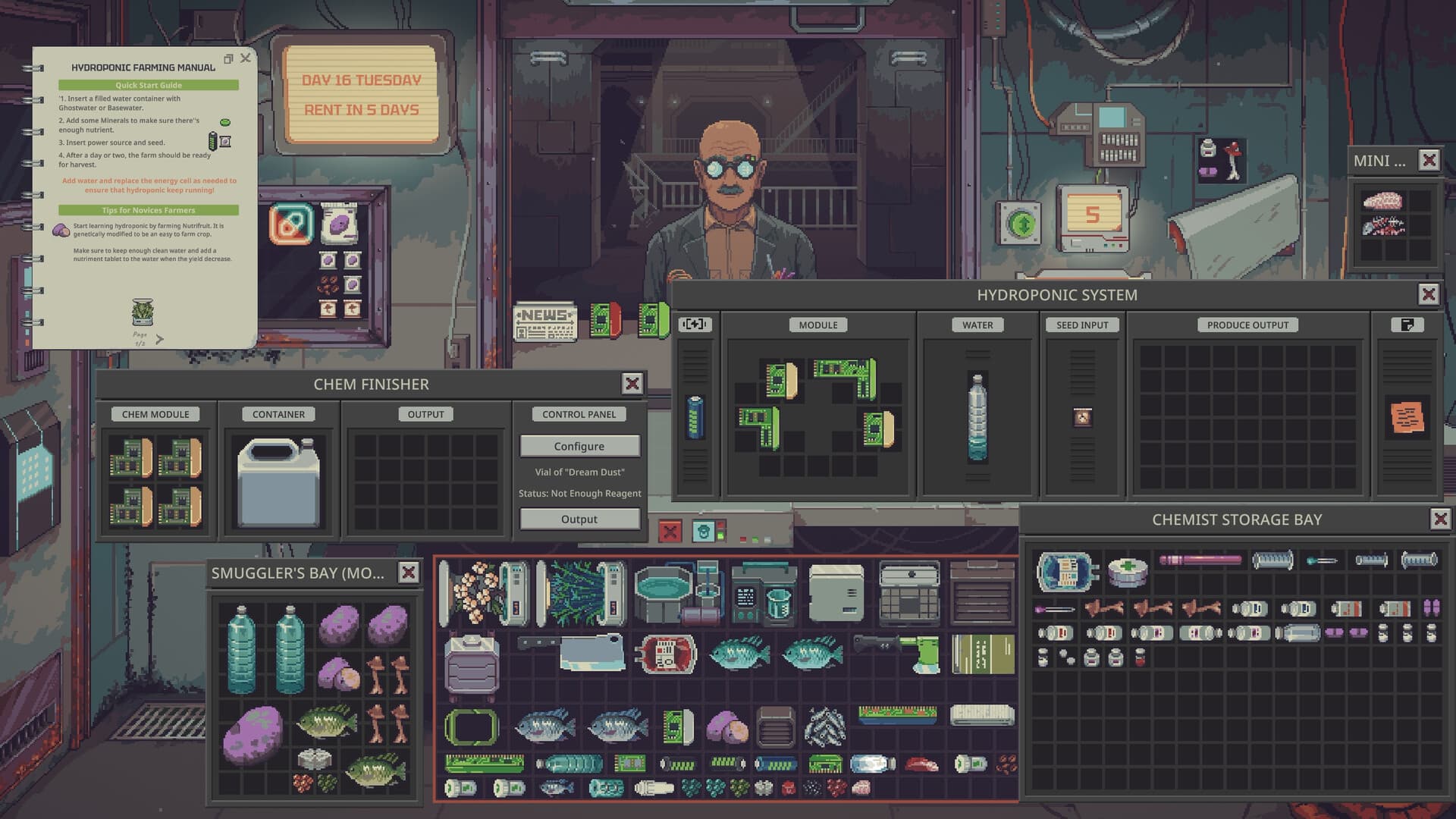
After drying, insert the container into the Chem Finisher, select Dream Dust or Caffeine Pill as appropriate, and press Output. The documented required volume is 2.00 mL of processed material per Dream Dust vial and 5.00 mL for the Caffeine Pill recipe. Those volumes describe processed input, not a guarantee that the material consists entirely of the active chemical, and the input must still meet the dry-ingredient requirement.
Wet Ingredient Detected means the input has not met the Chem Finisher's drying requirement. Check the Energy Cell, confirm that the container occupied the Evaporator's processing slot, and scan for remaining water or Alcohol. If liquid remains, allow another overnight evaporation cycle as necessary and inspect the composition before trying the Finisher again.
Not Enough Reagent instead means that the selected recipe lacks enough of its usable active ingredient. Check the selected product and look for Dream Cap Extract when making Dream Dust or Caffeine when making Caffeine Pills. A large container volume does not prove there is enough reagent, because solvent, water, and unwanted material can account for much of that volume.
Read purity grades and improve the right equipment
Purity depends on what remains mixed with the desired ingredient, so producing more vials does not automatically improve their grade. The manual lists Pure Grade at 99%+ with +135% base value, Pharma Grade at 90–99% with +85%, and Near Pharma at 80–90% with +40%. It lists Street Standard at 60–80% with no modifier, Cut Product at 45–60% with -45%, Junk Grade at 30–45% with -75%, and Starch Grade below 30% with -95%. These are the published range labels; their shared endpoints do not establish a unique boundary classification.
Equipment upgrades address different parts of production: the Blender improves extraction yield, while the Heating Plate improves maximum temperature, temperature control, and heating speed. Chem Finisher upgrades reduce impurities introduced during packaging, so their benefit concerns that stage of the process. Most chemistry equipment requires special Chemical Equipment Modules, but the Evaporator is an exception that uses normal modules.
Scan the completed product to assess its actual composition before deciding whether to deliver or sell it. A Labeler changes the displayed product label without increasing actual purity. Some customers carry a Chem Scanner to verify labeled purity, so changing the label does not substitute for improving the contents.
Keep Phanta's partial instructions separate
The manual identifies N-Methylol Base from Restricted Chemical Supplies as a Phanta precursor, but presents only partial information rather than a precise recipe. It says the accompanying Stabilizing Agent prevents reaction and must be removed, without supplying a removal method. It also warns that Phanta degrades above 130°C, so these details should not be treated as a complete production sequence.