To improve Dream Dust purity in Probably Stolen, preserve Dream Cap Extract during heating, remove contaminants, dry the mixture, and limit impurities introduced by the Chem Finisher. Check composition throughout production, because a full container or finished vial does not tell you how much useful extract it holds. Filtering helps with specific contaminants, while equipment upgrades address different sources of loss or added impurities.
Measure the ingredients before adding solvent
Attach a liquid container to the Blender and process Dream Caps into Dream Cap Mush, then inspect the contents with the Composition Spectrometer. The instrument displays ingredients, chemical composition, and contaminants, giving you a measured starting point for extraction. The production sequence continues through Dream Cap Extract and drying before packaging; selecting Dream Dust in the Chem Finisher cannot replace a missing extraction stage.
The guide's account of Chemistry 101 recommends Alcohol equal to 3–6 times the measured volume of Dream Cap Mush. Calculate that addition from the solvent's actual Alcohol content, rather than treating every part of the bottle's liquid as Alcohol. A player specifically reports water in the small purple alcohol bottle, so using the whole solution volume as your Alcohol measurement can misrepresent what you added.
Protect the extract with careful heating
GamerBlurb recommends approximately 40°C to 49°C for Dream Cap Extract, a cautious target within the broader 40–60°C range described elsewhere. Its explanation places extract formation at 40°C, conversion of remaining mush into Plant Matter at 50°C, and extract breakdown at 60°C. Because the guides differ around the upper limit, avoid reaching 60°C and treat these temperatures as guide recommendations rather than a verified official reaction table.
The starting Heating Plate can display a target as high as 99°C, but that setting is not a recommended Dream Dust temperature. Monitor the actual temperature and switch off the plate once the intended extract has formed instead of leaving the container heating. If overheating has already destroyed extract, further evaporation will not recover it, and drying a mixture that never extracted correctly will not complete the missing reaction.
Remove Protein without leaving excess treatment chemicals
If the blended mixture contains unwanted Protein, the guide recommends small, measured Acid additions with composition checks between them. Forum advice similarly favors gradual treatment with a fine dropper, warning that excess Acid or Base can become another impurity. Use the scan after each addition to assess what remains rather than assuming that adding more treatment chemical always improves the batch.
Forum contributor KogasaGaSagasa describes Protein treatment and Acid/Base counteraction using a 1:1 ratio. That is an individual player's account, not an officially confirmed guarantee that a calculated dose leaves no unwanted residue. Players also recommend scanning different Acid/Base batches and filtering their physical contaminants before use, but that advice does not establish that Heavy Metal or Mineral contamination is removable by the same method.
Filter in stages and check chemical-treatment conditions
After extraction, strain the mixture through Kotton Fabric to remove larger contaminants. Although optional for the basic recipe, this step is useful when improving finished-product quality. Forum players recommend following Kotton with a Water Pitcher containing a Water Filter, transferring the mixture into another container afterward, so that coarse plant pulp is handled before the filter tackles smaller material.
Treat the staged filter setup as player advice for particular unwanted material, without assuming it clears every contaminant category. Water-purification tablets have a separate condition: forum replies say chlorine needs at least 1 mL of water to work. Another reply warns that using a tablet without water can severely damage yield, so check the mixture for water before attempting this player-reported treatment.
GamerBlurb warns that chemical residue may remain in a Water Pitcher and contaminate liquid subsequently poured through it. If you also treat drinking water, its practical recommendation is to keep separate pitchers for the businesses whenever possible. Players report reaching Near Pharma with basic equipment and filtration, but those individual results do not promise the same grade from every batch or establish a guaranteed route to Pure.
Dry the batch fully before packaging
Place a compatible container in the Evaporator's CONTAINER slot and supply an Energy Cell for overnight operation. The drying step removes Water and Alcohol, but a single night does not guarantee that both have disappeared. Larger batches or mixtures with additional solvent may need more nights, so inspect the remaining composition before deciding that the material is ready for the selected recipe.
If the Chem Finisher displays Wet Ingredient Detected, the input has not met its dry-ingredient requirement. Check that the Evaporator had sufficient power, that the container occupied its processing slot, and whether Water or Alcohol remains. Continue evaporation when needed and scan again; changing the label does not satisfy the drying requirement, and this warning alone does not establish that extraction must be repeated.
Check what the Chem Finisher contributes
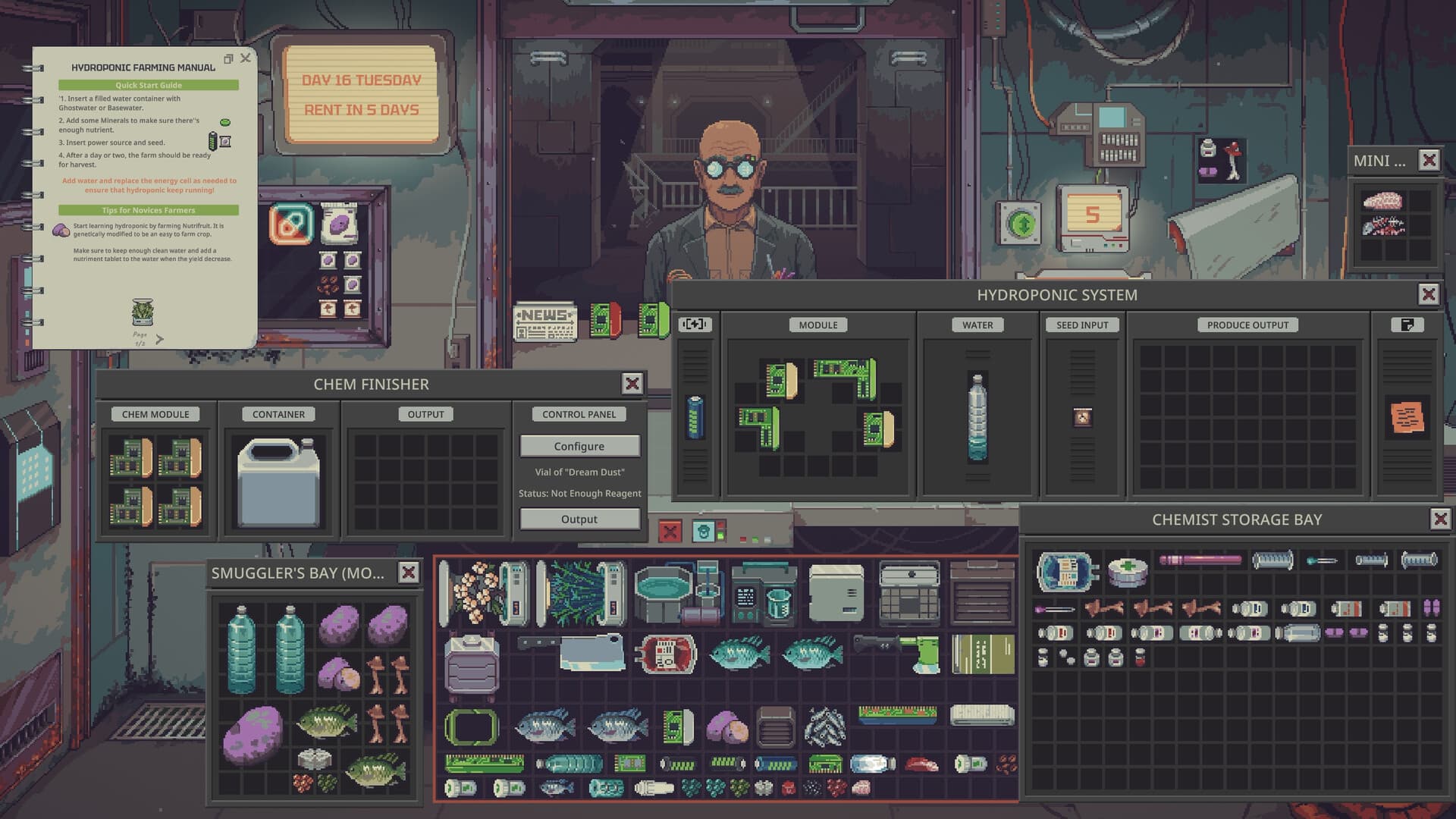
Configure the Chem Finisher for Vial of Dream Dust and press Output when the dry material is ready. Each vial uses 2.00 mL of processed material, which does not mean it contains that volume of pure Dream Cap Extract. The guide illustrates this with a 56.50% vial holding 1.13 mL of extract, with physical contaminants, minerals, and Protein among the remaining contents.
Bonus Action's launch-build guide reports that the Chem Finisher itself adds 12% impurity before upgrades. It lists 6%, 3%, and 1% with successive Chemical Equipment Modules, then no added impurity with four modules. Forum advice also identifies full upgrading as necessary to stop packaging from adding impurities, but this does not clean an already contaminated input or guarantee a Pure result.
Choose upgrades according to the problem you observe: Blender extraction performance concerns useful material recovered, while Heating Plate improvements concern temperature control. Chem Finisher chemistry upgrades address impurities introduced during packaging. Recovering more material in the Blender should therefore not be read as a guaranteed increase in purity grade, and the finished vial still needs a composition check.
Read purity grades and troubleshoot the right warning
The guides list Pure at 99%+ with a +135% base-value modifier, Pharma at 90%–99% with +85%, and Near Pharma at 80%–90% with +40%. They list Street Standard at 60%–80% with no modifier and Cut Product at 45%–60% with -45%. The remaining categories are Junk at 30%–45% with -75% and Starch below 30% with -95%. These are grade modifiers rather than final transaction prices, and the overlapping range endpoints do not settle which grade wins at an exact boundary.
Not Enough Reagent concerns insufficient usable active ingredient for the selected recipe, rather than the wet-input problem. For Dream Dust, inspect the Dream Cap Extract amount instead of assuming that a large total container volume supplies enough reagent. A Labeler only changes the displayed label, and buyers carrying a Chem Scanner can compare that claim with the real composition. Scan the finished vial to judge the result of your extraction, cleanup, drying, and packaging.