To make Dream Dust in Probably Stolen, blend Dream Caps into mush, extract it with Alcohol, evaporate the remaining liquids, and package the dry residue with the Dream Dust recipe. The production chain uses the Blender, Heating Plate, Evaporator, and Chem Finisher in that order. Measure the mush before adding solvent, monitor the extraction temperature, and confirm that Water and Alcohol have disappeared before packaging.
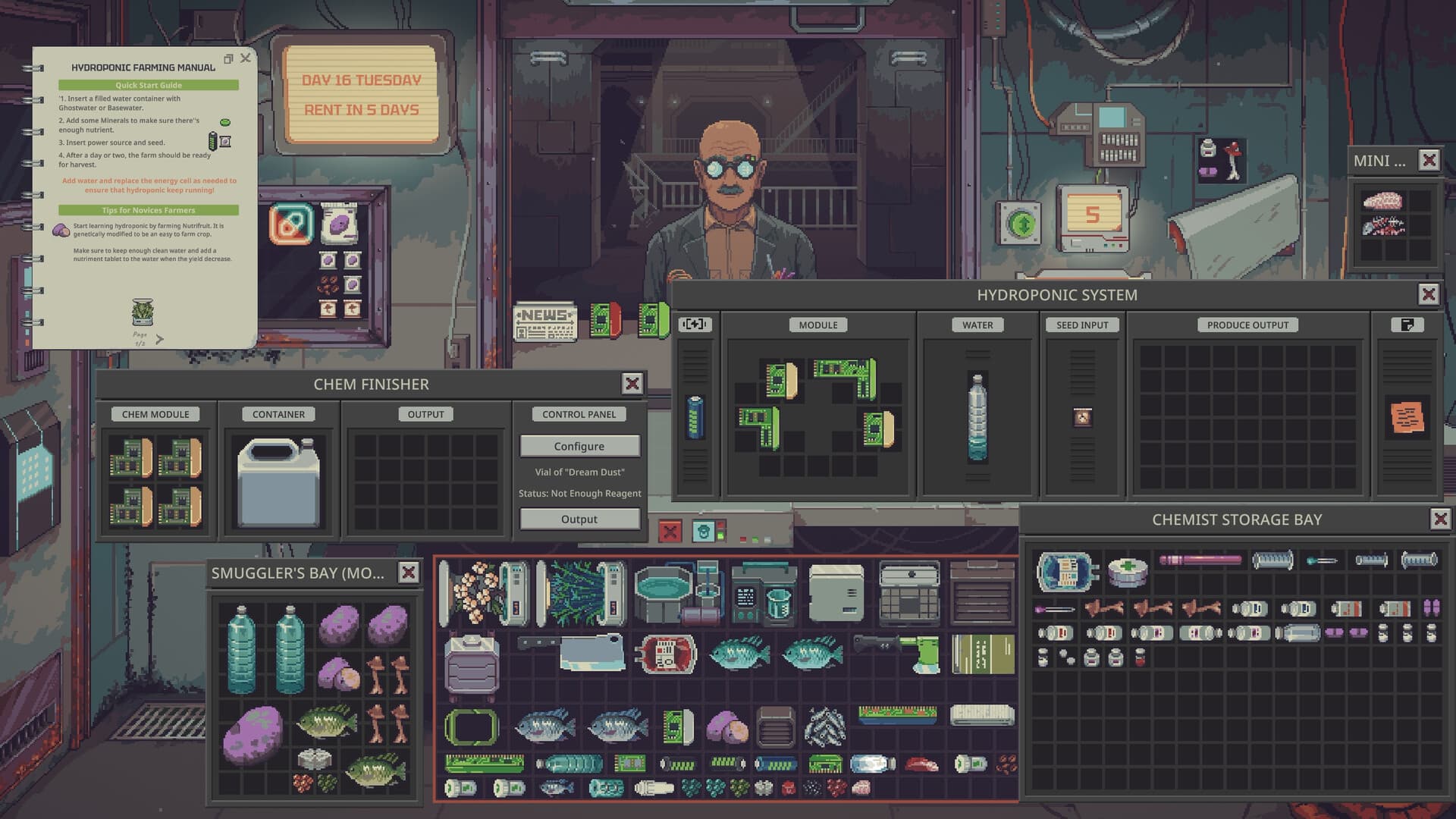
Unlock chemistry and prepare your equipment
Chemistry is available through the Chemist start or by buying Retired Chemist from Wild for 1,000 credits. The accompanying equipment includes the Chemistry 101 Guide, Composition Spectrometer, production machines, measuring tools, Water Pitcher, and Kotton Fabric. Keep Dream Caps and Alcohol available for production rather than selling all your ingredients as ordinary merchandise.
The Composition Spectrometer, also called the Chem Scanner, shows the contents of liquid containers and chemical products. Use it after blending to measure usable mush, during heating to check extract formation, and after evaporation to look for remaining liquid. These checks distinguish a batch that needs more drying from one whose extraction never produced the intended ingredient.
Blend Dream Caps and measure the recovered mush
Attach a liquid container to the Blender, add Dream Caps, and run the machine to produce Dream Cap Mush. Scan the resulting contents before calculating the Alcohol addition, because the recipe depends on the recovered mush volume. The starting Blender can have 35% Content Loss, so the amount of raw material inserted does not directly establish how much usable ingredient remains.
Measure Alcohol and control the extraction temperature
The manual specifies Alcohol equal to 3–6 times the volume of Dream Cap Mush. A guide uses approximately five parts Alcohol per part of mush, with 20 mL of mush and approximately 100 mL of Alcohol as its example. That example falls within the manual's range; it does not establish a uniquely correct ratio or the fastest extraction.
Measure the actual Alcohol content rather than assuming a bottle's capacity or the mixture's total volume represents pure solvent. Graduated cylinders and droppers help control additions before the container goes onto the Heating Plate. Check the temperature setting before heating, since the machine's available target is not automatically suitable for Dream Dust.
The manual lists an extraction range of 40–60°C and explicitly warns that overheating destroys Dream Cap. GamerBlurb recommends approximately 40°C to 49°C as a more conservative target, reporting unwanted conversion or breakdown at higher temperatures. Monitor actual temperature and extract formation, then switch off the Heating Plate once the intended reaction has occurred.
Filter contamination before concentrating the mixture
Kotton Fabric filtration is optional in the basic recipe and removes larger contaminants before evaporation. Steam players describe using Kotton for plant pulp and an ordinary filter for smaller material, while a guide also describes using a suitable filter with a Water Pitcher. Treat those filtering combinations as player experience rather than a guaranteed route to a particular purity grade.
If the Chem Scanner shows unwanted Protein, the guide suggests small, measured Acid additions. Inspect the composition between additions so the cleanup does not leave excessive Acid in the mixture. Use those composition checks to guide further additions rather than assuming that the same amount suits every batch.
Evaporate until the batch is actually dry
Place the compatible batch container in the Evaporator's CONTAINER slot and supply an Energy Cell. The machine works overnight to remove Water and Alcohol, and the described starting Evaporator requires 6 Energy per day. That energy figure applies to the starting equipment described by the guide, rather than every possible upgraded configuration.
Check the composition after the overnight cycle instead of treating the next morning as proof that drying is finished. Larger batches or additional solvent can require multiple nights, and the machine handles one connected batch container at a time. Wait until all Water and Alcohol have evaporated before moving the residue to the Chem Finisher.
Select Dream Dust and package the residue
Insert the dry residue into the Chem Finisher and select Dream Dust, shown as Vial of Dream Dust in the guide's configuration instructions. Confirm the chosen recipe before pressing Output, because the machine can package other products as well. Each vial consumes 2.00 mL of processed residue, which should not be confused with a requirement for that volume of pure Dream Cap Extract.
The guide's 56.50% example contains 1.13 mL of Dream Cap Extract within a 2.00 mL vial. The remaining material includes contaminants, minerals, and protein, so the composition determines actual purity. Inspect the finished product with the scanner; changing its displayed label with a Labeler does not improve the chemical contents.
Resolve wet ingredients and missing reagent
Wet Ingredient Detected means the input has not met the Chem Finisher's dry ingredient requirement. Check the Evaporator's power, the container's placement, and remaining Water or Alcohol, then run another night if necessary. The documented error example occurred during Caffeine Pill production, so it illustrates the shared drying warning rather than a Dream Dust batch test.
Not Enough Reagent instead indicates insufficient usable active ingredient for the selected product. For Dream Dust, inspect the Dream Cap Extract content rather than relying on a large total container volume. Further evaporation cannot create extract that never formed during heating or recover extract already destroyed by overheating.
Improve purity and reserve qualifying vials
Choose upgrades according to the stage that needs improvement: the Blender affects recovered yield, the Heating Plate improves temperature control and heating performance, and the Chem Finisher can introduce fewer impurities. Most chemistry machines use special Chemical Equipment Modules, while the Evaporator uses normal modules and can improve energy efficiency and overnight processing. A larger batch can yield more vials without raising their grade, so inspect extraction, filtration, and packaging separately.
The guide records starting equipment producing 46.95% and later 56.5% Dream Dust, both within Cut Product. Those are batch observations rather than promised results, and Cut Product carries a -45% base value modifier. The manual places Street Standard at 60–80% with no price modifier and Near Pharma at 80–90% with +40%, although its written ranges overlap at their endpoints.
In the guide's Chemist opening, the first Cartel collection required 10 vials at a minimum of 40% purity the following week. After that successful delivery, the recorded requirement rose to 15 vials at 45% purity or higher, so check your handler's current terms rather than assuming those conditions always apply. Reserve enough qualifying vials before selling surplus, since additional low purity stock cannot replace bottles that meet the required minimum.