To grow crops in Probably Stolen, unlock Hydroponic Farming, supply a Hydroponic System with water, nutrients, an Energy Cell and a seed, then let the plant grow overnight. Keep water and power available as growth continues, and collect the harvest from the output slot when the crop is ready. Water quality and nutrient levels affect plant health, so maintaining the system matters for the size of your harvest.
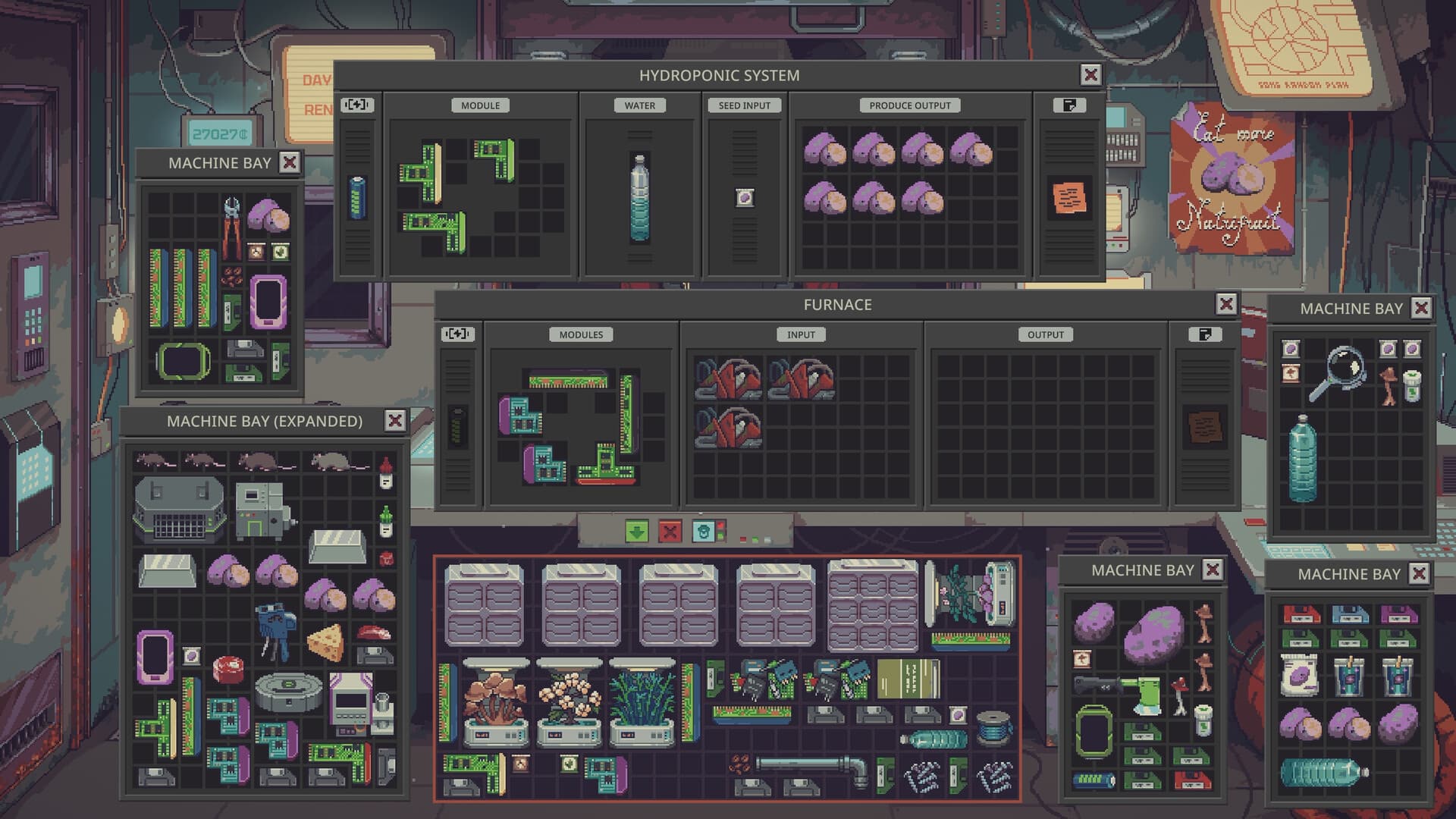
Unlock farming and check your starting equipment
You can begin with the Hydroponic Farmer specialization or unlock farming during a run by purchasing Retired Farmer from Wild for 350 credits. The launch-build trade guide places access to Joe Wild’s Network on day 7, which is the route it describes for unlocking trades after starting. The farming unlock provides an old Hydroponic System, the Hydroponic Farming Manual, Fillerweed and Nutrifruit seeds, Nutrient Tablets and small Water Rations.
If you choose the Hydroponic Farmer start, check the condition of its Decrepit Hydroponic System before relying on it. The trade guide describes four stuck modules, including two ruined ones, and recommends obtaining a Module Extractor. The Retired Farmer also visits weekly with a Hydroponic System, seeds, Nutrient Tablets, a Plant Analyser, an AquaScan and farm modules. The listed seed stock includes Dream Cap, Kotton, Coffee, Fillerweed, Hydroreed and BloomBerry.
Prepare the system and maintain overnight growth
The manual’s quick start calls for a filled container of Ghostwater or Basewater, Minerals, a power source and a seed. The trade guide makes the preparation order more explicit: add the cleanest water available, put a Nutrient Tablet into that water, and insert the seed. Use an Energy Cell to power the Hydroponic System; the launch-build guide reports consumption of 8 power per night. These are the basic inputs to check before leaving the plant to grow.
Growth progresses each night until the plant is ready, at which point the harvest moves into the output slot. Keep adding water and replace the Energy Cell as needed to keep the system running. Use the crop estimates below as planning references, because the trade guide gives different base growth times for different plants. For an approachable starting crop, the manual recommends Nutrifruit, which it describes as genetically modified to be easy to farm.
Manage water, Minerals and falling yields
Water with a low concentration of contaminants is the usual choice, unless the crop has particular needs that call for something different. Certain contaminants can harm growth, but Minerals are nutrients rather than contaminants. Plants need Minerals, and both a shortage and an excess can reduce yield. Each plant has its own nutrient concentration tolerance, so increasing Minerals without considering the crop is not a reliable solution.
The manual says excess Minerals are usually preferable to a deficiency, while still warning that too much can have a negative effect. Use a Plant Analyser on a seed to inspect its needs and current health when deciding how to care for it. For Nutrifruit specifically, the manual advises keeping enough clean water available and adding a nutrient tablet when yield decreases. Together, water quality and nutrients determine plant health, which in turn determines harvest size.
Choose crops for food and production materials
Fillerweed has an estimated base growth time of about 2 nights and supplies inexpensive edible filler while returning seeds. Nutrifruit takes about 3 nights in the trade guide’s base estimate and produces food with 3 seeds returned. These crops give you food outputs, whereas several other plants supply materials for further production. Hydroponics connects to Chemistry, Winemaking, Rat Ranching and direct food sales, so crop choice can follow the production activity you want to supply.
Coffee’s estimated base growth time is about 3 nights, and its Coffee Beans are an ingredient for Caffeine Pills. Hydroreed also has an estimate of about 3 nights, cleans the water it grows in, and produces Hydroreed Filters when its module is used. BloomBerry takes about 3 nights initially, followed by roughly 2 nights per subsequent fruiting. Its berries are used for wine, and the bush survives harvest, giving it a different harvest pattern from a crop described only by its initial growth time.
Dream Cap has a base growth estimate of about 4 nights and supplies Dream Caps for contraband Dream Dust. Kotton also takes about 4 nights in the guide’s estimate and produces Kotton fiber. With the Kotton Loom module, its output is Kotton Fabric instead. Treat these timings as approximate base estimates from the trade guide rather than a promise that every plant will be ready on an exact night.
Use modules for specific crop outcomes
Farm modules can change the use or status of a crop, so choose them for the output you actually want. The Dream Cap module makes Dream Caps legal food and increases yield, while the Nightmare Cap module turns Dream Caps into Nightmare Caps. The Smuggler module removes contraband status from growing seeds. Keep that scope in mind: the stated Smuggler effect concerns growing seeds, while the Dream Cap module has its own stated food and yield effects.
Unlock Plant Genetics and inspect traits
Plant Genetics is a further unlock that requires buying Retired Farmer first, then purchasing Plant Genetics from Wild for 1,250 credits. It provides a DNA Manipulator, a Gene Scanner and four blank DNA Data Disks. Dr. Jackson then stocks additional disks, manipulators and DNA modules. The system lets you copy traits such as Fast Grower and Bountiful between plants.
Switch on the Gene Scanner to examine the target’s traits and genetic complexity before choosing what to edit. Check the success chance displayed on the machine before beginning an operation. Higher complexity and repeated edits make the process slower and riskier, so having access to genetics does not make every attempted change equally safe. Each edit also heats the plant’s genetics, and the trade guide advises letting it mature before editing again.
Extract and install traits with the right safeguards
To extract a trait, put a blank disk in the output slot and the source plant in the target slot. The DNA Manipulator copies a random trait onto the disk, and extraction destroys the source plant unless a Genetic Stabilizer module is installed. A Positive Trait Filter restricts extraction to good traits, while a Negative Trait Filter restricts it to bad traits. Do not install both filters together when you want to extract, because that combination blocks extraction entirely.
To install a stored trait, place the written disk in the input slot and the receiving plant in the target slot. Each successful installation consumes a disk charge, and installing a trait the plant already has increases its rank. Before repeating an edit, consider both the displayed success chance and the advice to let the plant mature. That keeps the installation process tied to its actual constraints: available disk charges, increasing editing risk and the plant’s recovery between edits.