To run Gunsmithing in Probably Stolen, unlock the trade, supply a powered printer, and match your finished guns to each customer's required order stats. Weapon permits govern which firearm tiers you can trade legally, while modifications help you meet the customer's specifications. The recipe costs, unlock prices, and permit thresholds below follow the launch-build trade guide, so check your current in-game descriptions before committing resources.
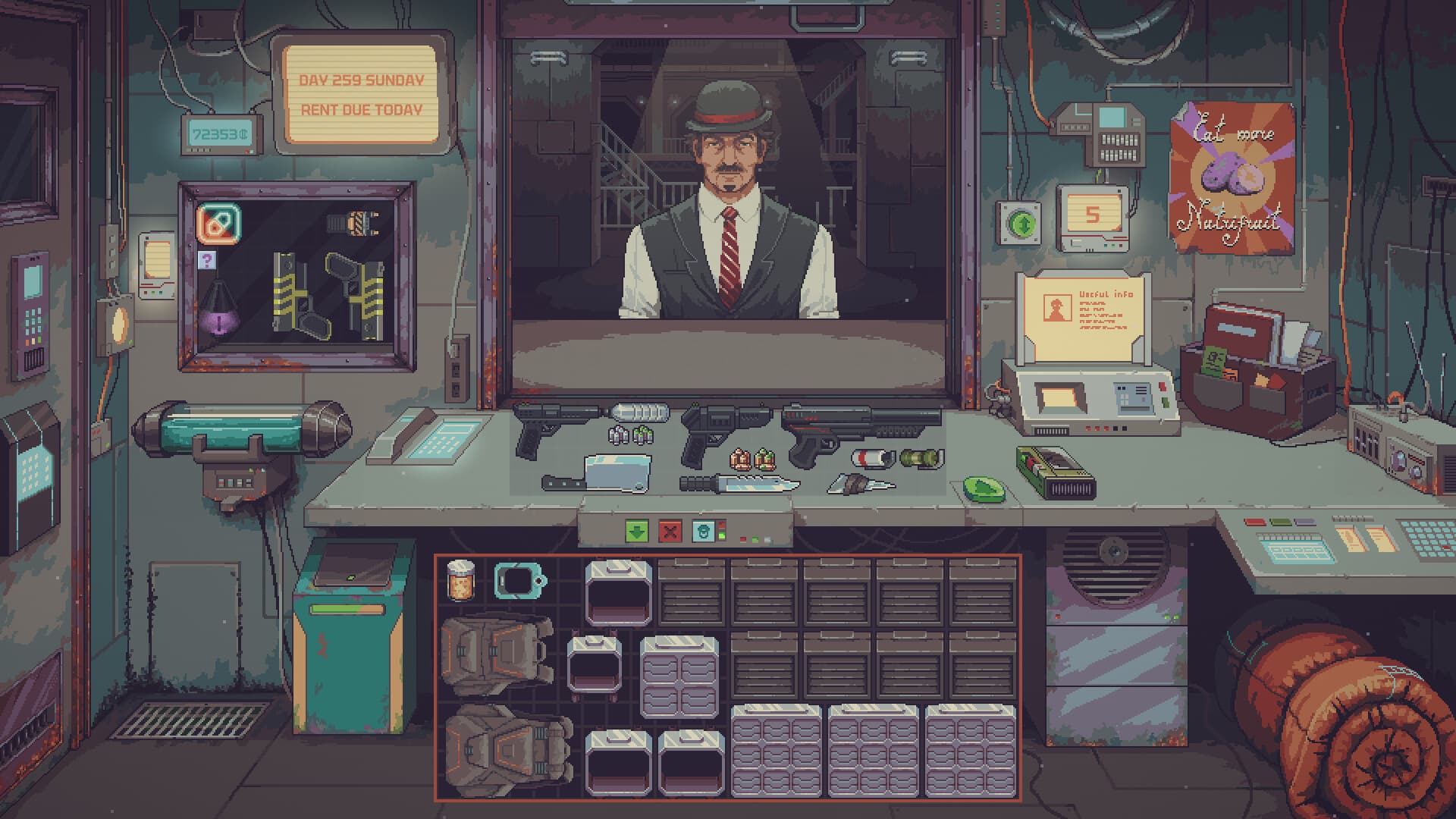
Unlock Gunsmithing and establish your supply
Choose the Gunsmith starting background, or unlock the trade during a run by buying Retired Gunsmith from Wild for 650 credits. Joe Wild's Network becomes accessible on day 7, making that route an alternative to selecting the trade at the beginning. The retired visitor unlock provides a starter kit immediately, and the visitor subsequently returns with trade stock every week.
The kit includes a shabby 3D Printer with a charged cell, a Liberator pistol chip, filament, a Screwdriver, a gun part, and mods. The Retired Gunsmith's weekly stock includes chips, filament, mods, and printer modules, with additional permits making rare chips and modules more likely. In the Weapons Trader video's Gunsmith opening, the starting package also includes a class one weapon permit, firearms, mods, and ammunition, and skips the introduction.
Keep permits valid before expanding your stock
Weapon Permit I costs 300 credits, is delivered at 20 Security reputation, and makes low-level firearms and ammunition legal. Weapon Permit II costs 600 credits, requires 50 Security reputation for delivery, and covers mid-level firearms and ammunition. Weapon Permit III costs 900 credits, is delivered at 80 Security reputation, and covers high-level firearms and ammunition.
The revocation thresholds differ from the delivery requirements: Permit I is revoked below 0 Security reputation, Permit II below 30, and Permit III below 60. An officer takes the permit away if your Security reputation falls below its revocation line, so buying it does not settle legality permanently. Covered guns stop counting as contraband but retain half the usual contraband markup, and displaying the class one permit increases the chance of gun-buying customers visiting.
Set up the printer and allow production time
Insert an Energy Cell and the relevant printer chip, then add the materials that chip requests, such as filament, scrap metal, or metal ingots. With the required power source, chip, and materials in place, the printer works automatically overnight rather than producing the item immediately. Larger prints can require multiple nights, so an unfinished item after the first night does not by itself mean the setup has failed.
Read the job's own work requirement and progress speed instead of assuming every chip takes the same time. One demonstrated project requires 50 work with a progress speed of 27 a day, but those figures describe that particular job and machine configuration. Printer modules are locked while the machine is working, so plan module changes around the completion of the active print.
Choose recipes for pistols, magazines, and mods
The Liberator Pistol chip uses 2 filament to produce 1 pistol, while Double Liberator Pistol uses 3 filament for 2 pistols. For .22 magazines, the standard, high-capacity, and extended versions respectively consume 1, 2, and 3 filament, with each batch producing 2 magazines. The 10mm standard magazine uses 3 scrap metal for 2 magazines; its high-capacity and extended versions use 2 and 3 scrap metal respectively, each producing 1 magazine. All three 10mm magazine versions require Metal Printing.
Improved Springs uses 2 scrap metal to produce 4, and the demonstrated Improved internal springs description identifies Reliability as a benefit without establishing a fixed increase. A Red Dot Sight batch uses 3 scrap metal and 1 electronic part for 2 sights, whereas Laser Sight uses 2 scrap metal and 1 electronic part for 2. The launch-build recipe table groups Makeshift Red Dot and Toy Laser under a cost of 1 filament plus 1 electronic part and an output of 4; that shared entry does not establish that they are the same item.
Print frames, assemble guns, and refurbish stock
Nestfire Compact Frame requires 1 metal ingot for 1 frame, while Ironcraft 10 Frame requires 1 metal ingot plus 1 scrap metal for 1 frame. Both frame recipes require CNC and Metal Printing, so having the raw metal and chip alone is insufficient. The Gun Parts printing recipe likewise lists a Metal Ingot, its dedicated chip, a Metal Printer Module, and a Computer Numerical Control Module alongside the printer.
A Gun Parts item finishes either a Nestfire Compact Frame or an Ironcraft 10 Frame into a gun in New condition. Gun Parts can also come from disassembling firearms with a Screwdriver and can refurbish used firearms, with repeated attempts increasing the refurbishment chance. Other listed sources include Thief, Eleanor, and the Dumping Ground, while the Gunsmith start and Retired Gunsmith starter kit each include a Gun Parts item.
Fill required order stats before chasing bonuses
Read the specific order before choosing a gun: lower-level buyers request basic guns, mercenaries request mid-tier guns, and upper-level buyers request high-tier guns. Requirements can involve Firepower, Style, Reliability, Recoil Control, Ergonomics, Accuracy, Size, or Suppressed, and every required condition must be met for the sale. Bonus requirements add credits but are optional, so an otherwise qualifying gun can sell without satisfying every bonus.
Service orders work differently because the customer brings the gun and you fit the parts, receiving payment for those parts plus a service fee. Keeping some mods separate from your own firearms is a useful inventory approach for these jobs, as the Weapons Trader video suggests. For a “Give me your best” order, the stated payment is the gun's market value plus 50%; that formula applies to this order type rather than every custom request.
Supply metal for advanced printing
Smelting supplies Metal Ingots for Gunsmithing, and the launch-build guide says Dr. Jackson gives you a Furnace for free on day 6. Put an Energy Cell in the Furnace, which consumes 8 power per night, then add two Scrap Metal, two Metal Ore, or one of each. A Flux Smelting Agent is optional, and the overnight process produces one Metal Ingot.
Ore is available from Caulson at GP Mining Coop through a 250-credit introduction from Wild, while scrap comes from the Dumping Ground and scrap sellers. A Furnace fitted with Junk Processing converts six Junk into four Scrap Metal, providing another way to supply recipes that consume scrap. After the initial Furnace gift, Dr. Jackson stocks a Furnace, the Metallurgy Manual, and furnace modules.