In Probably Stolen, Weapon Permits I, II, and III make low-, mid-, and high-level firearms and ammunition legal, respectively, subject to credit costs and Security reputation requirements. Gunsmithing also covers printing gun parts and modifying weapons to meet customer orders, so permits are only part of running the trade. The costs, thresholds, recipes, and procedures below apply to the launch build described by the trade guide.
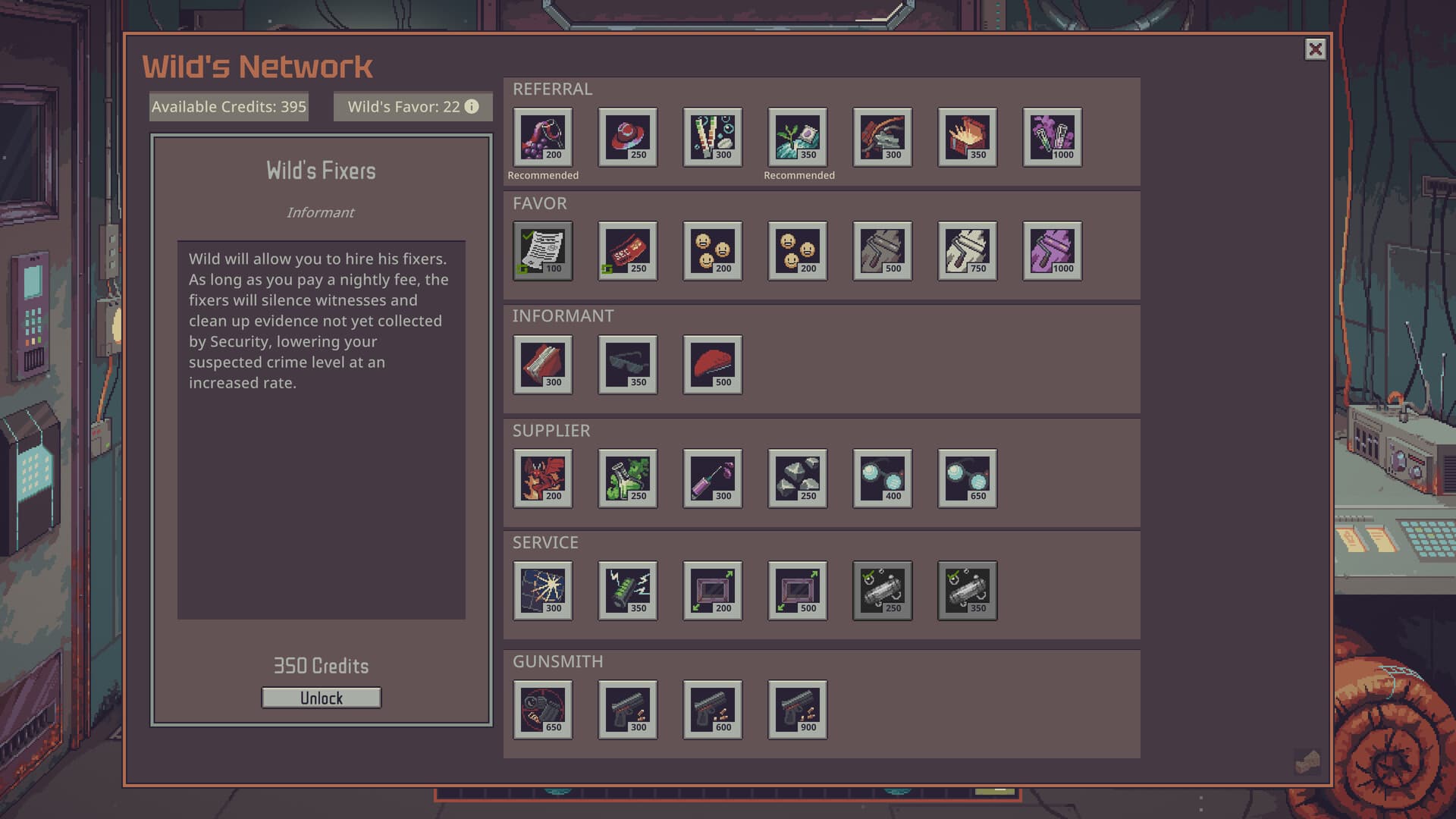
Weapon permit costs and Security reputation
Weapon Permit I costs 300 credits and is delivered when your Security reputation reaches 20. It covers low-level firearms and ammunition, with revocation triggered if Security reputation falls below 0. These are separate thresholds: the reputation required to receive the permit is higher than the point at which you lose it.
Weapon Permit II costs 600 credits, requires 50 Security reputation for delivery, and is revoked below 30. This tier makes mid-level firearms and ammunition legal. Weapon Permit III costs 900 credits and requires 80 Security reputation for delivery, covers high-level firearms and ammunition, and is revoked if reputation drops below 60.
Keep Security reputation above your permit's revocation line, because an officer will take the permit away if you fall below it. A covered gun stops counting as contraband but retains half the usual contraband markup when sold. That reduction applies to the markup component, so it does not mean that the gun's entire selling price is halved.
Unlock Gunsmithing and find supplies
You can unlock Gunsmithing by choosing the Gunsmith at the start or buying Retired Gunsmith from Wild for 650 credits. The mid-run route uses Joe Wild's Network, which becomes available on day 7. Choose your route around when you want access to the trade: the Gunsmith is a starting option, while the Network provides access during an existing run.
The listed starter equipment includes a shabby 3D Printer, a charged cell, filament, a Screwdriver, a gun part, and mods. The Retired Gunsmith visits weekly with chips, filament, mods, and printer modules. Each extra permit increases his likelihood of bringing rare chips and modules, giving permits a supply benefit alongside their legal coverage.
Run the printer and check module requirements
To start printing, put an Energy Cell in the 3D Printer and insert a printer chip. Add the materials that the chip requests, which can include filament, scrap metal, or metal ingots. Leave the printer working overnight, but allow more than one night for larger prints rather than assuming every recipe finishes after the same interval.
The Nestfire Compact Frame recipe uses 1 metal ingot to produce 1 frame. Ironcraft 10 Frame requires 1 metal ingot plus 1 scrap metal for 1 frame, while Gun Part turns 1 metal ingot into 3 parts. All of these recipes require both CNC and Metal Printing, so check the module requirements as well as the material quantities.
Separate legal coverage from production requirements when planning a customer order. Weapon permits determine which firearm and ammunition tiers become legal, while the frame and gun-part recipes specify the materials and printer modules needed for production. Having CNC and Metal Printing does not itself establish that a gun is covered by your permit. Likewise, holding a permit does not remove the CNC and Metal Printing requirements listed for those recipes.
Compare pistol, attachment, and magazine recipes
The Liberator Pistol chip produces 1 pistol from 2 filament, while Double Liberator Pistol produces 2 pistols from 3 filament. Improved Springs turns 2 scrap metal into 4 springs. The Makeshift Red Dot / Toy Laser entry lists 1 filament and 1 electronic part for an output quantity of 4.
Red Dot Sight requires 3 scrap metal and 1 electronic part to produce 2 sights. Laser Sight also produces 2 sights, using 2 scrap metal and 1 electronic part. The Suppressor chip turns 5 scrap metal into 2 suppressors, so its material requirement differs from either of those sight recipes.
For .22 Magazine, the standard, high-capacity, and extended recipes use 1, 2, and 3 filament respectively, each producing 2 magazines. The corresponding 10mm Magazine recipes use 3, 2, and 3 scrap metal, with outputs of 2, 1, and 1 respectively. Those 10mm recipes require Metal Printing, so their listed scrap quantities alone do not describe everything needed to make them.
Match guns to customer orders
Lower-level buyers request basic guns, mercenaries ask for mid-tier guns, and upper-level buyers request high-tier guns. Read the individual order's requirements before deciding which weapon to modify. The listed attributes can include Firepower, Style, Reliability, Recoil Control, Ergonomics, Accuracy, Size, or Suppressed, so the customer's tier alone does not describe the full job.
A customer buys when the gun meets every required condition on the order. Bonus requirements add extra credits, making them worth checking after the mandatory requirements are satisfied. Treat required and bonus conditions separately when reviewing a build: meeting an optional condition does not replace the need to satisfy all the required ones.
A “Give me your best” order pays the gun's market value plus 50%. Service orders work differently because the customer brings a gun and you fit the parts. The customer then pays for those parts plus a service fee, so use the service-order payment structure rather than applying the “Give me your best” premium to every job.
Use melee recipes alongside gun production
Kitchen Knife uses 3 scrap metal and 1 filament to make 4 knives, while Meat Cleaver uses 5 scrap metal and 2 filament to make 4 cleavers. Combat Knife instead uses 2 metal ingots for 5 knives, and Combat Machete uses 3 metal ingots for 3 machetes. The combat recipes require Metal Printing, and the Melee Batch Module adds an extra weapon to every melee print.
Supply metal ingots through Smelting
Smelting converts scrap metal and ore into Metal Ingots that can supply Gunsmithing. You can start it for free when Dr. Jackson gives you a Furnace on day 6. Afterward, he stocks the Furnace, Metallurgy Manual, and furnace modules, providing a continuing source for that equipment.
Put an Energy Cell in the Furnace, which uses 8 power per night. Load two Scrap Metal, two Metal Ore, or one of each, optionally add a Flux Smelting Agent, and leave the batch overnight for one Metal Ingot. Ore comes from Caulson at GP Mining Coop through Wild's 250-credit introduction, while scrap comes from the Dumping Ground and scrap sellers. The Furnace's Junk Processing module also converts six Junk into four Scrap Metal.